Show
Court 3
Curated by Jane O’Neill, Rod Laver Arena Complex, Melbourne Olympic Parks
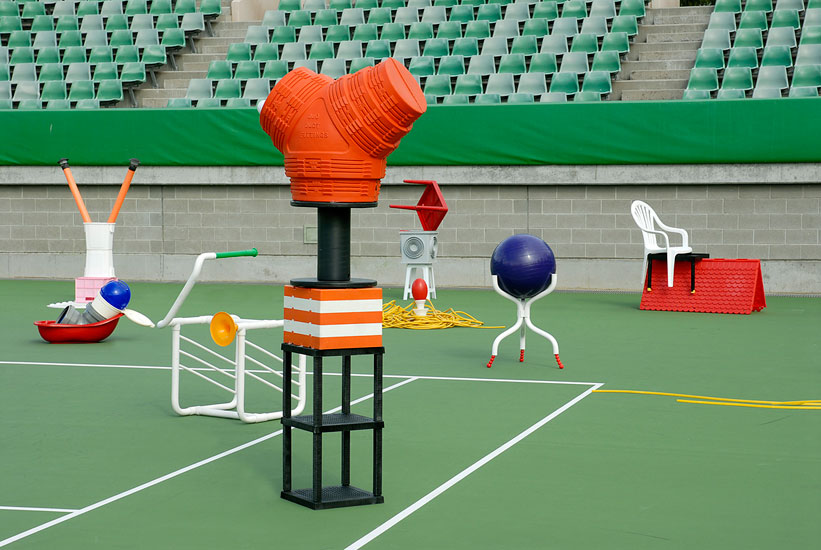
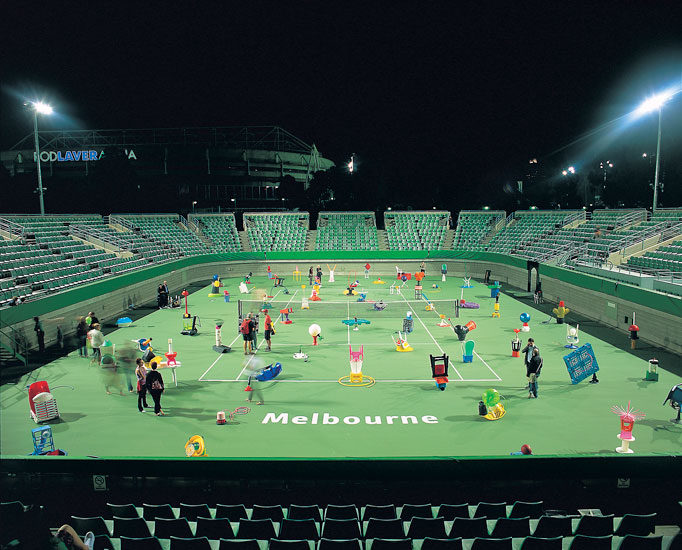
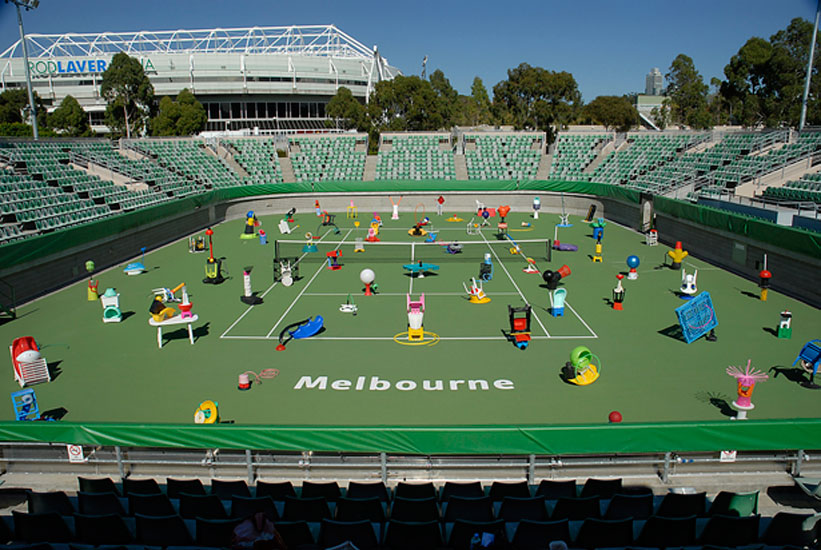
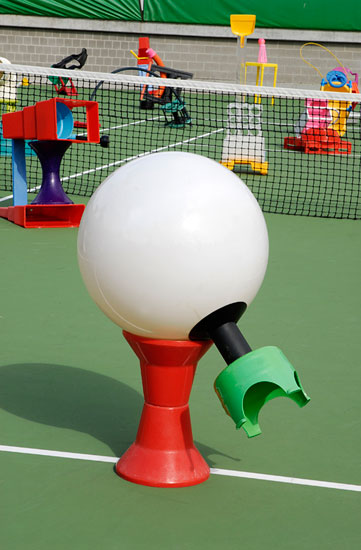
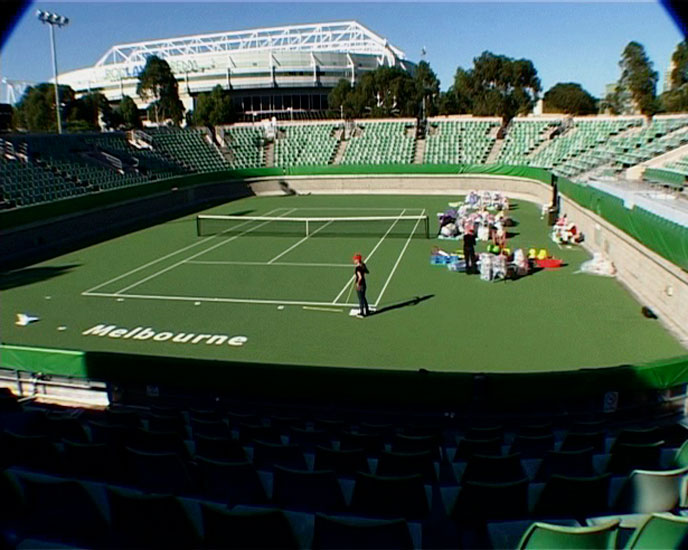
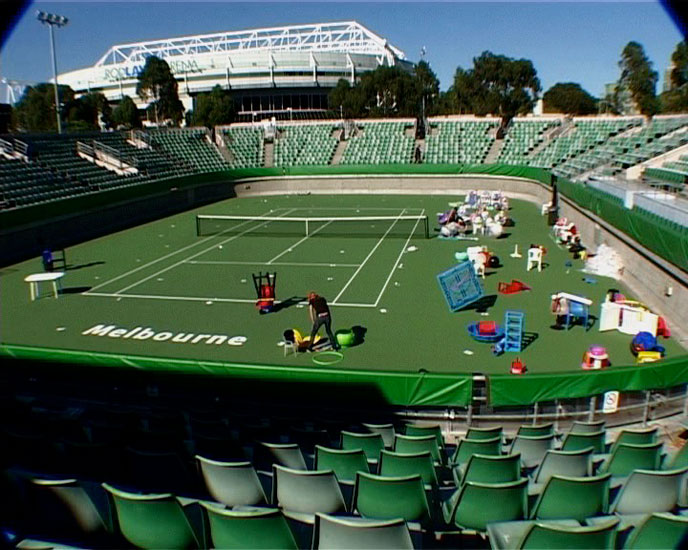
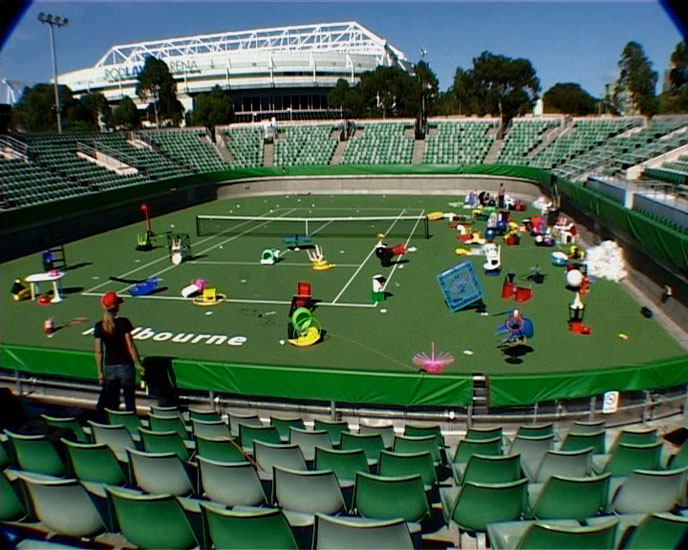
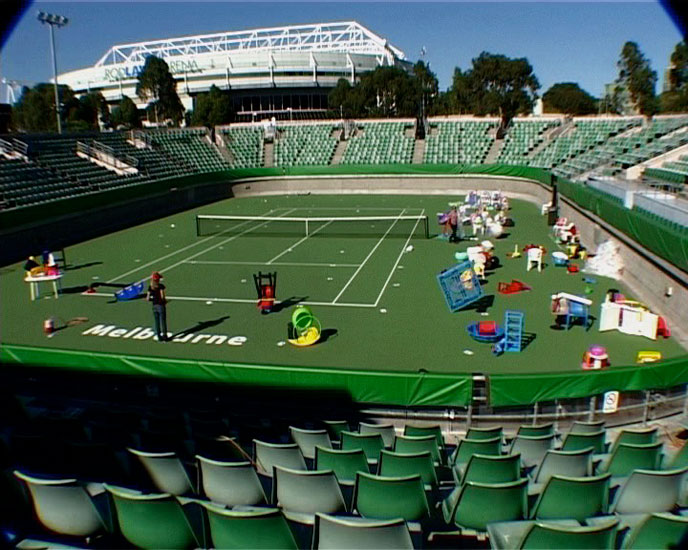
Show Court 3 was a 3-day event which involved setting up 75 sculptures
in a professional outdoor tennis court, thus transforming a non-art environment
into a transient museum. The project successfully diffused the cultural
barrier between art and sport, albeit momentarily, whilst offering viewers a
playful yet stimulating experience.
A catalogue was produced by Nellie Castan Gallery in 2009 and was launched, along
with documentation of the project, with the exhibition Mood
Bomb in 2009.
Photos: John Brash
Video Stills: Annie Wilson
Catalogue essay
by Jane O’Neill:
SHOW COURT 3
A curious and often remarked upon aspect of Australian art history is that
many of its key stylistic innovations have been the result of local artists’
reliance on poor reproductions in order to keep in touch with developments
overseas: grainy black and white photos of works shown in Europe and North
America have inspired Australian artists to produce works which, had they
been exposed to foreign art in the original, might never have come into
existence. Such events are bound to happen less often now, with the efficient
dissemination of images through advanced technology; but the spectacle
of Show Court 3, staged outdoors at Melbourne Olympic Parks, is the result
of just such a mis-interpretation.
The exhibition was inspired by an image of The Happy Ending of Franz Kafka’s Amerika; a work presented by Martin Kippenberger at the Museum Boymans-van Beuningen in Rotterdam in 1994. Kippenberger’s installation consisted of a great number of tables and pairs of chairs placed in various interview settings and arranged across what appears to be an indoor sports stadium. The pieces of furniture recall different eras of design. Kippenberger, in a discussion about the work, remarked that “everyone will remember a chair that embodies something or other, and then you are transported to that time, as if you were carrying around a visual encyclopaedia with you”.[1] Kippenberger’s use of a sporting stadium as a backdrop emphasised the degree to which the modern interview situation is like a sporting event, in the sense that it requires strategic action in a rule governed environment.
When I encountered the first series of Jam Session sculptures by Louise
Paramor at Nellie Castan Gallery in 2006, I was reminded of an image
I had seen of Kippenberger’s work. Paramor’s works recall the culture
of the discarded; plastic items mostly gleaned from the jumbles of rubbish
placed at street kerbs. Her works share with Kippenberger’s, “the whole
idiom of the found, mixed up with reproductions and with self-designed
ideas”[2] Paramor’s use of furniture to evoke the absurd nature of human
interactions also struck a familiar chord.
In jam sessions a white sun lounge wrapped around a rocking horse conjures
notions of containment, perhaps the swaddling of a child or a type of
pregnancy. Botticelli's Venus is recalled as a shelf penetrated with
hosing rises up out of a blue clam-shell […]. The general ambience is
that of a deserted kindergarten or playground, leaving the viewer in
a similarly isolated position.[3]
As a result of the similarity I perceived between Kippenberger’s work and Paramor’s, I approached the artist and suggested a sporting stadium as an exhibition venue for the sculptures. Only once the search for a venue was underway did I discover that Kippenberger had in fact fabricated the look of an indoor soccer field within a museum; The Happy Ending of Franz Kafka’s Amerika, complete with astroturf backdrop was re-staged at the Tate Modern in 2006.
As is often the case when an attempt is made to stage a contemporary
art project outside of the gallery, the idea was met with doubt by officials
at the sport centre. A major concern was that the sculptures would damage
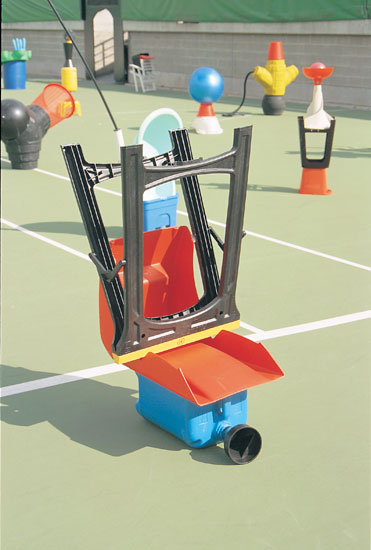
the surface of the court. To allay such fears, Paramor trundled an example
of her sculpture to the meeting: a white plastic chair with hosing of
various colours protruding. The fact that this chair was exactly the
sort that officials at tennis tournaments sit on convinced the court
managers that the sculptures could cause no harm, and so a date was set.
When viewing exhibitions at art galleries, it is common to see the art
in the context of other work exhibited in that particular space. Here,
at Melbourne Olympic Parks, Paramor’s exhibition tended to be seen and
compared with the other forms of mass entertainment the venue has hosted.
The sculptures created a jarring visual disruption when placed in a location
normally associated with play and movement. The stadium seating surrounding
the tennis court incited an expectation of frenetic entertainment; a
number of viewers sat looking at the sculptures, as though waiting for
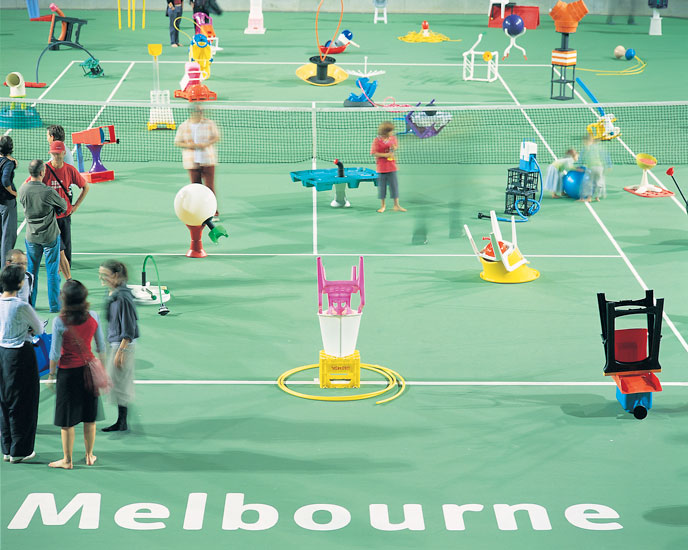
them to spin and jump around. For most, the exhibition reversed the usual
role of visitors to such stadia: at such places one generally sits and
watches others move; here the objects on the tennis court were static,
it was the spectators who moved around.
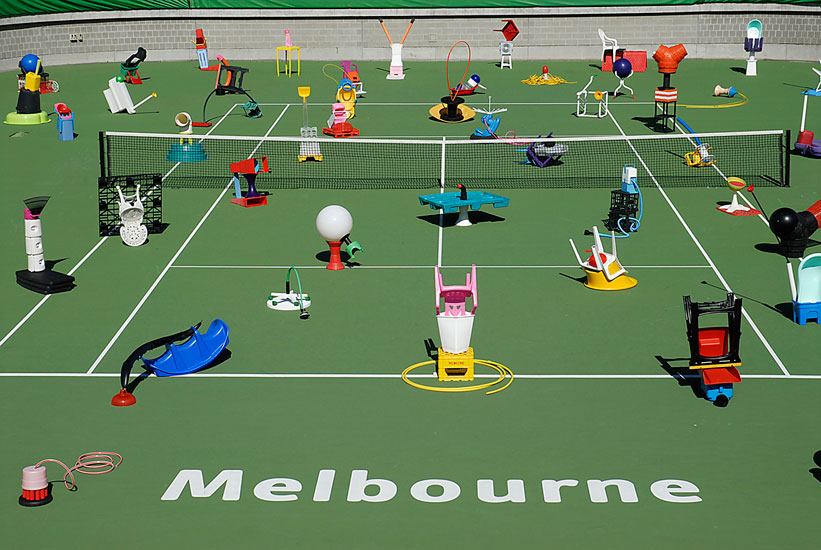
The installation offered a kaleidoscope of juxtapostions and interpretations.
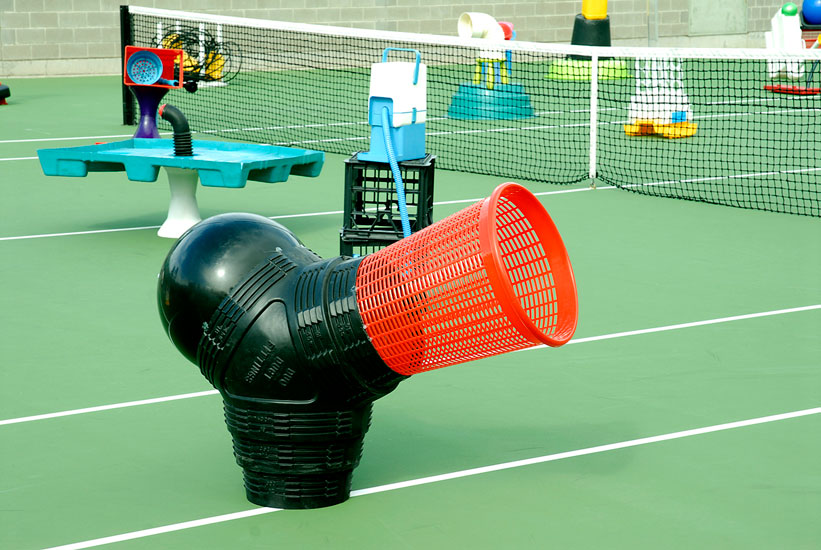
Some of the works hinted at the theme of tennis. A bulbous red and black
form suggested the shape of a ball machine and the lines of a black milk
crate resonated with those of the court net. The collection invited the
viewer to a game of playful exploration: searching out repetitions of
particular objects, colours or shapes. The recurring use of balls, hula
hoops and baby baths created a sense of structure and continuity across
the sculptures, while colour provided a rhythm. The idiosyncratic palette
of domestic plastics became apparent: the vividness of its hot pinks,
the rarity of its purples. Children gravitated to the cubby houses, hula-hoops
and sandpits, frustrated by their playful appearance. Mothers recognised
the baby baths and children’s furniture as objects no longer confined
to the world of everyday drudgery. It was possible for every viewer to
form fresh visual and tactile connections with materials which had otherwise
had their place in the mundane operations of domestic life.
Overwhelmingly though, the works address not only our experience of inanimate
objects but also human interaction. Much of Paramor’s practice deals
with the themes of love and sexuality. Through these sculptural pieces
the artist expresses the surprising complexity of human physicality.
…because the objects Paramor collects are designed for the human body,
above all for hands and arses, the jam sessions acquire anthropomorphic
qualities, even characters of their own, at once innocent and faintly
obscene.[4] For instance, the way the artist jams things into each other
seems to mimic the sex act. In one work, the two poles that protrude
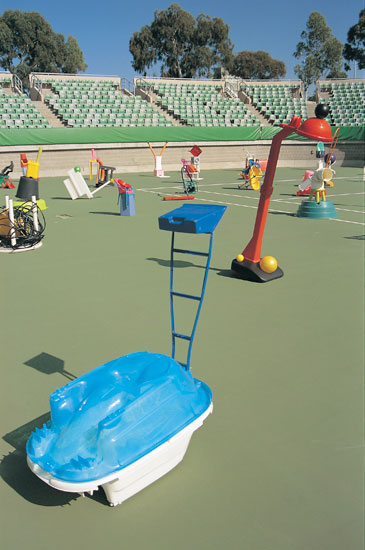
from a bin resemble legs splayed wide in the air. Elsewhere mint green
baby baths are configured so as to resemble the smooth head of a penis.
Staged within a sporting arena, we might well regard the exhibition as
a tournament of fictional calisthenics.
There is a thirty minute video film of the installation and de-installation of the exhibition.[5] It emphasises the physicality of the artist’s involvement. We see her moving about the court carefully placing each of the works. While the photographic documentation presents the work as a finished product, in the video the exhibition appears a kind of marathon event. For Paramor, it was indeed an act of physical and mental endurance. In the lead up to the exhibition, the artist spent a year systematically collecting items, cleaning the plastic, creating the works, dismantling the works, labelling, packing and storing the pieces. In exhibition week, the works were packed, unpacked, placed, assembled and exhibited. As the artist staggered to the finish line on the last rainy day of the exhibition, the works were dismantled, thrown in the back of a truck and driven away.
[1] Roberto Ohrt, Kippenberger. Cologne: Taschen, Cologne,
1997, p.183
[2] ibid, p.18
[3] Jane O’Neill, A Bunch of Flowers, Perth Institute of Contemporary
Art, Western Australia, 2006.
[4] Justin Clemens, Show Court 3, The Monthly magazine, July 2007, p.
65.
[5] Filmed by Annie Wilson the film is shot at intervals of 1 second
every thirty for the installation and de-installation of the exhibition.
Show Court 3 was reviewed in Realtime Magazine,
The Monthly Magazine and The Herald Sun newspaper.
The time-lapse DVD of the installation of Show Court 3 and seven Jam
Session sculptures were included in the travelling exhibition Under
My Skin (2008/9), an Asialink project curated by Sarah Bond and
Georgia Sedgwick.