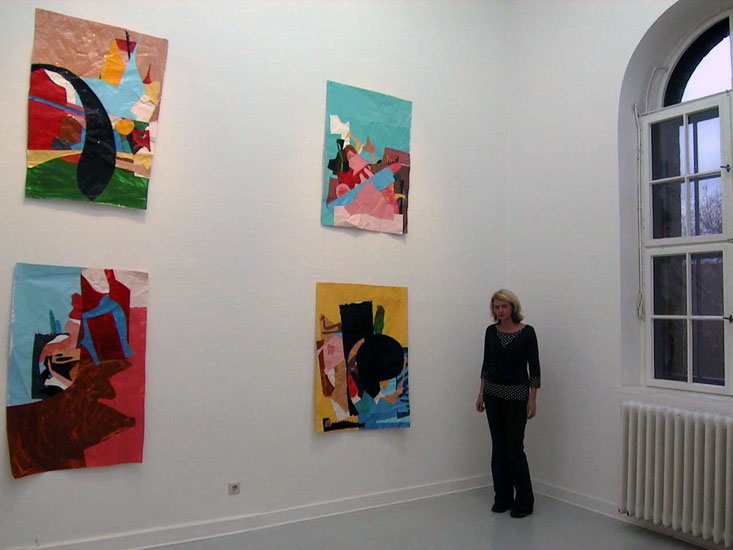
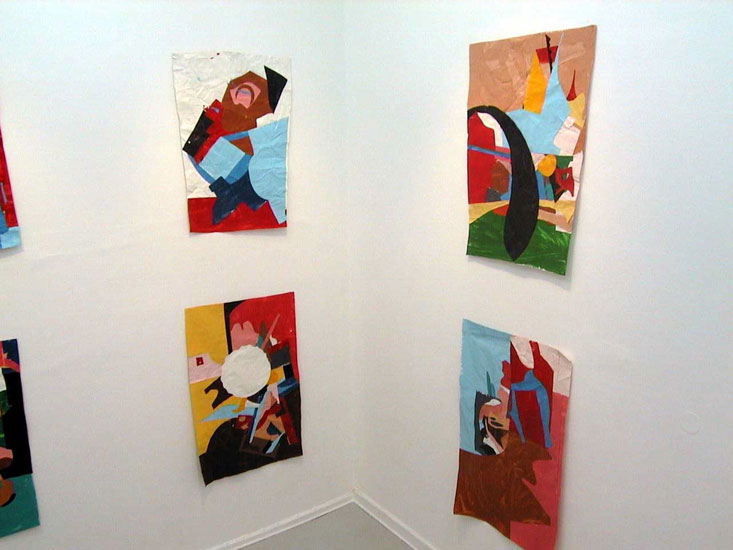
Off-Cuts
Künstlerhaus Bethanien, Berlin
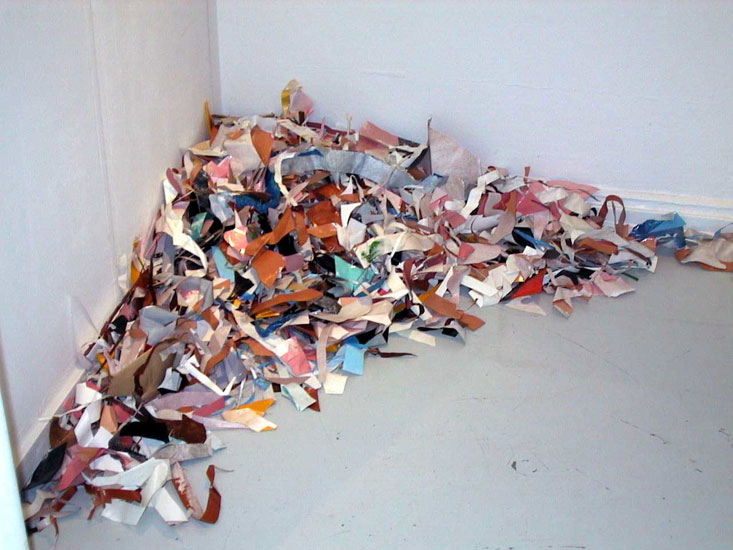
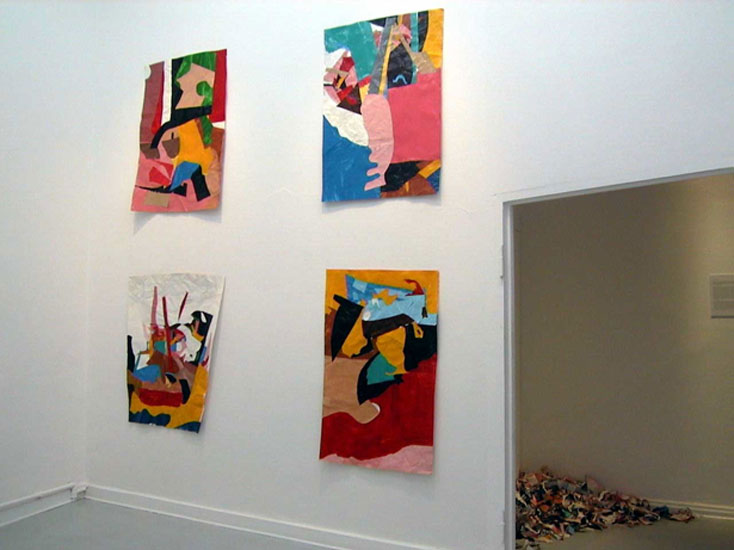
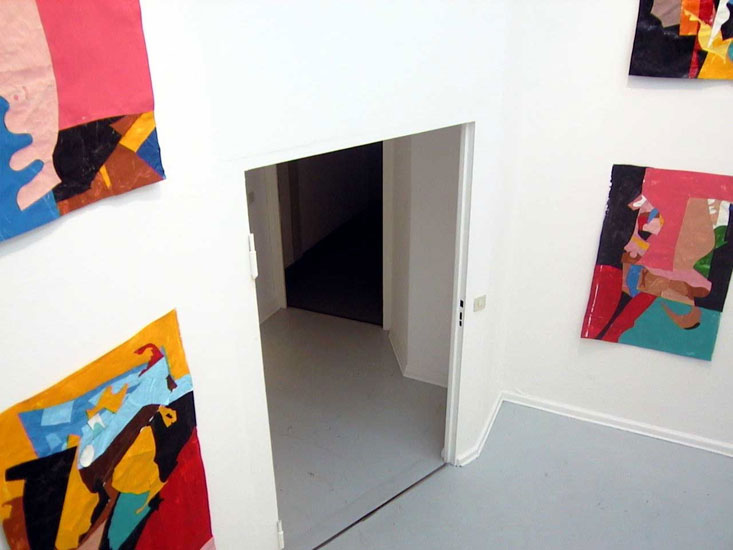
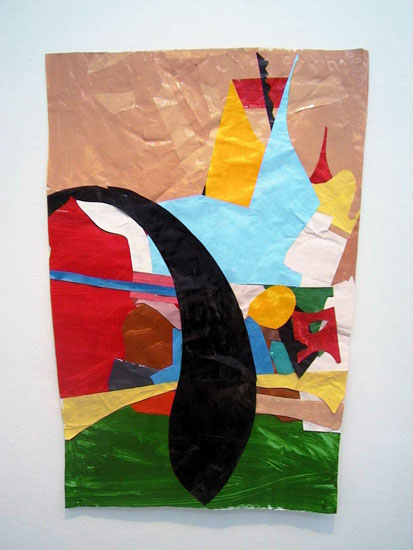
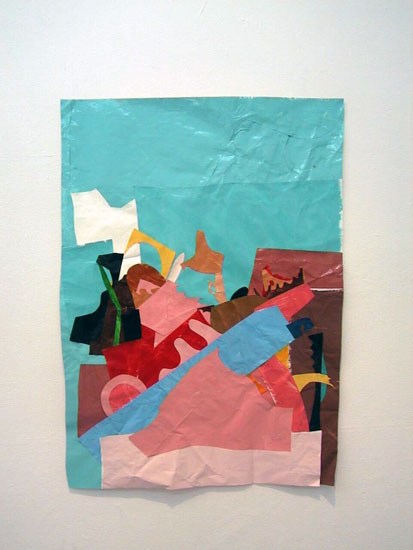
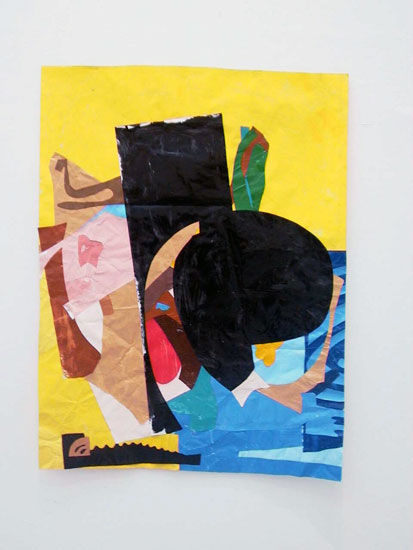
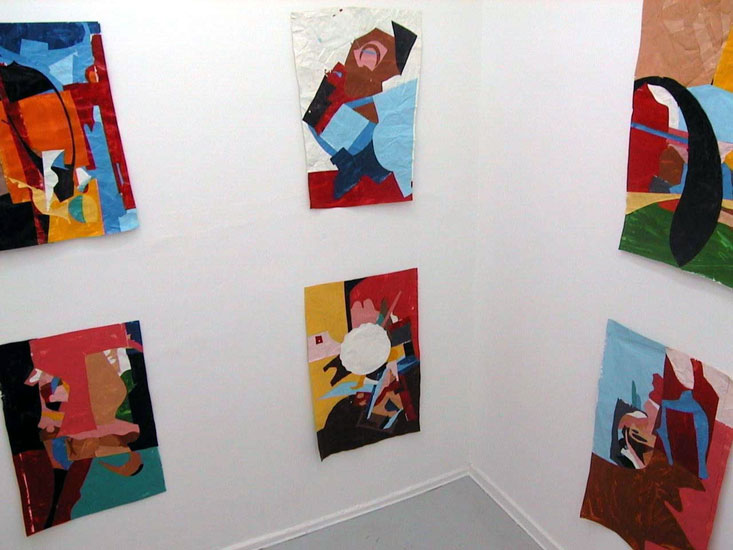
Off-cuts was an exhibition of the first in a series of abstract collages
constructed from the refuse of the FOREVERYOURS series of collages.
Gallery text by Richard Grayson:
Something to Declare
Had you been a reasonably diligent customs officer on the green entry lane at
one of Berlins’ several airports you could have easily plunged yourself into
the center of one of those rather baroque detective cases beloved of writers
of a certain metaphysical bent had you asked a fair-haired woman to open one
of her bags as she was passing so that you could check it for contraband.
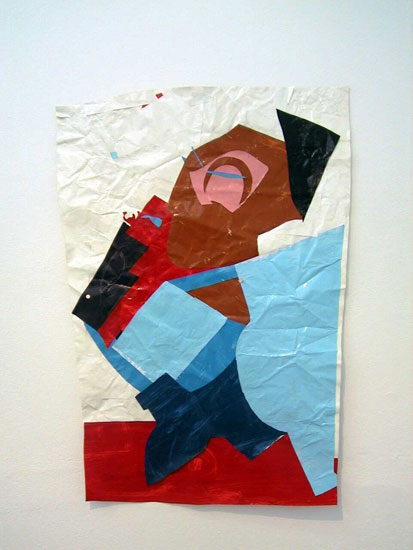
The woman was arriving from Singapore. In one package she had a series of art works that she had made there whilst in residence at one of the art schools. The works were, out of inclination and perhaps with practical concerns in mind – portability etc – collages, quite large, made from paper that had been treated with paint and then cut up and made into images drawn from those that are found on the front covers of books of popular romantic fiction: Mills and Boon and Romance Library. Good time blondes with their hair tied up in a bright scarf and their head thrown back, caught in a moment of laughter. Or maybe women reclining in a sultry manner in a nearly designer interior. Figurative images of someone else's idea of glamour, sexiness and sophistication - the type of imagery which you now can’t imagine anybody seeing as ‘uninflected’…like rockabilly music, it now travels with so many associations and cultural loadings attached that it is impossible to hear it just as invigorating noise or see the images merely in terms of a graphic style. These images bring with them an entire package of attitudes, social constructions, ideas, definitions of high and low, and particular ideas of where happiness may lie.
It’s the other package however that specifically concerns us here, although as we shall see the two are essentially linked – this is the one that would have plunged the diligent officer into the center of a Borgesian or Chestertonian mystery – as this package was full of the scraps left over from the makings of the other pictures. Half moons of red material, shapes looking as if they are left from dressmakers patterns, the shapes that are made by the making of other shapes. Casual boundaries, the result of process rather than direct aesthetic decisions. What in the art room at school used to be called ‘mess’ and which you were required to clear up at the end of the session. Well, Louise Paramor has not only cleared up her mess but she’s carried it some twelve thousand miles. She’s got a bag filled up with what is not in the other bag. This is enough to confuse the best of customs officers.
This bag contained the material that has been transformed into the works that we now see in front of us. In some sort of blended accelerated fiction of modernism, the material left over from the making of figurative works has been transmuted into abstractions. The negative spaces of representational practice isolated and reconfigured into the active febrile surfaces of the abstract Greenbergian picture plane. There are lots of serious jokes and delicious inversions in such a transformation, which trigger memories and echoes from the myths stories and narrations of modernism. I am strongly reminded of books published in the late sixties and early seventies that proved the inevitability of abstraction by taking a reproduction of Tiepolo or whatever and revealing its inner structure through inscribing circles and triangles over and around the figures indicating either that it was really abstract, or that it would have been abstract all along if Tiepolo had only had the guts. At the time this seemed sort of convincing and true, now it seems to be an ecstatic hallucination. There’s also a considerable nod to the foundation myth of the economy of modernism - a sort of Occams’ razor - adoring the modesty of means, the reductive, the simple expressing the multitude. This parallels ideas that it is the artist who sees the diamond in the gutter, the aesthetic structuring of the disregarded and overlooked: that the alchemy of the creative drive converts mute material into shining constellations. It is interesting to note that the cubist semi-figurative collages of Picasso and Braque used everyday materials in the form of newspaper and other material from the real world, but it was only with the totally abstract works of Schwitters that real rubbish got a look-in, picked up from the streets and the floor of busses and trams.
But what Paramor is using here isn’t quite the abject material of this operation in the same way that her abstracts, although as abstract as anything by Kurt, are not of the same nature, loading, or reading. We have all that history now, making the idea of ‘an abstract’ as contingent, as narrated and as inscribed, as the cover of any Mills and Boon. But it would be wrong maybe to see these collages in terms of a post-modern ironic re-articulation of abstraction. It’s not as contained as that. As the work is a process as much as a resolution there’s something that is material and resistant to neat readings, something that keeps speaking rather than being spoken for, something to be declared.