
Heart-On
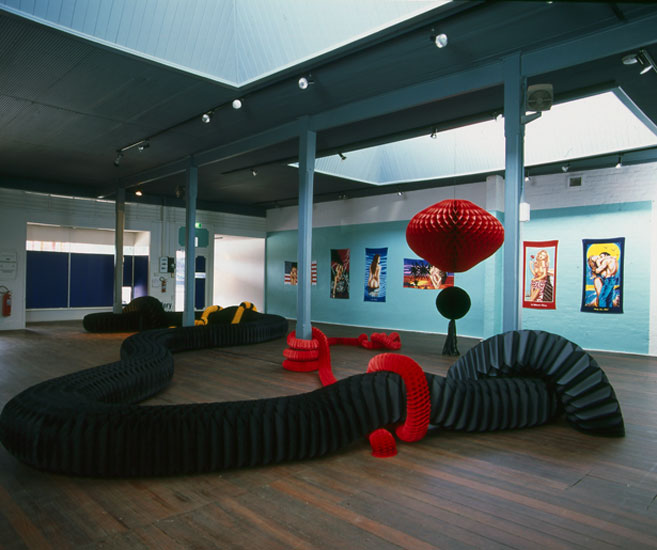
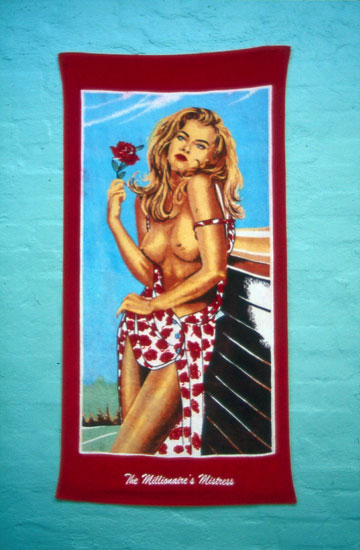
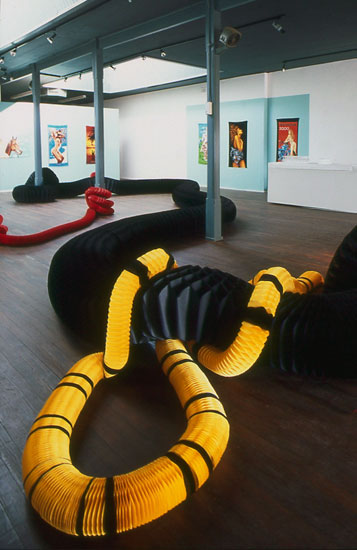
Heart-On was an exhibition of honey-comb paper sculptures, found
objects and borrowed text, and was created during a 3-month residence
at IASKA (International Art Space Kellerberrin Australia)
IASKA catalogue text by Boris Kremer:
Such Lush Femininity -On decoration, romance and deceit in the work of Louise Paramor
“Such lush femininity…a cloud of shiny brown curls bouncing around a
soft, beautiful face... skin gleaming like honey satin... an appealing
freshness about her lemon dress which somehow accentuated the sensuality
of full breasts thrusting against it, the seductive sway of perfectly
curved hips, the graceful movement of long legs. Its line of buttons
could open all of her to him...” (1)
Were one to give a style sheet description of Louise Paramor’s latest works, this might just be the adequate literary style to do so. Ample bosoms, glistening wet thighs, firm, pear-shaped buttocks; such are the bodily attributes of Paramor’s “beauties” teasing the viewer in a purposeful attempt to “send a surge of blood to his loins”. (2)
In 2001, during a three-month-long “outback residency” at the International
Art Space Kellerberrin Australia - IASKA, the Berlin-based, self-proclaimed ”Love
Artist” (3) was to experience an intense feeling of both geographical
and social remoteness. Seeking escape from her isolation, she instinctively
cast herself in the role of an addicted dime novel reader, investigating
the imaginary space of pulp fiction. Having confronted her own reality
with the romanticised ideals that make our wishful dream worlds, she
set out to complete an installation that would visualise these conflicting
realms. Under the tacky headline Heart-On, her exhibition in
the rather conservative Wheatbelt community of Kellerberrin, WA, alternatively
struck the chords of sexual lure and deceit.
While the interior of the exhibition space was concealed covering the
front windows in thick acrylic paint, the show1s apparently sleazy intents,
enshrined in its frivolous title, were boldly marked in gold vinyl lettering
across the entrance. In the locals’ minds, there was little doubt that
this rather “full-on” setting, reminiscent of red light districts the
world over, was geared at luring honest folks with the forbidden promise
of readily available, lascivious sexuality. Once inside, lusting trespassers
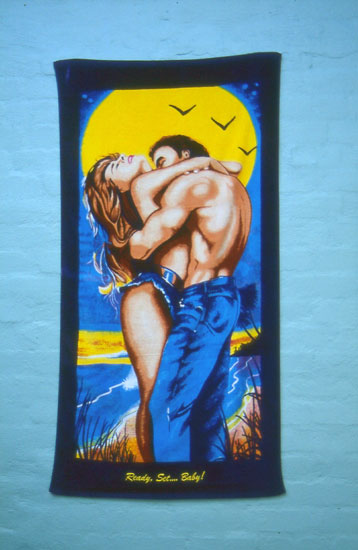
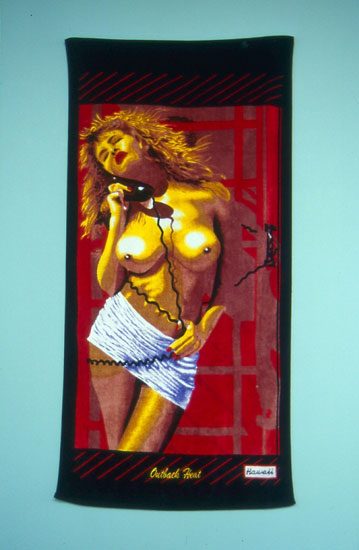
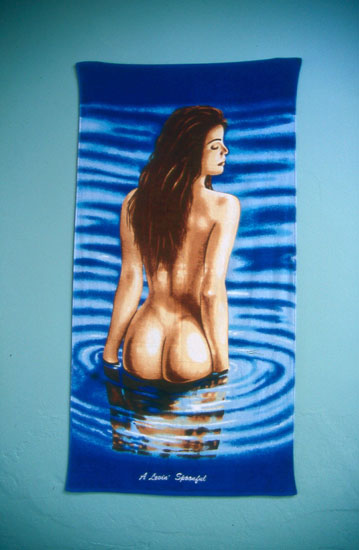
would in fact find themselves contemplating rather innocent girlie beach
towels, embroidered with duplicitous quotes borrowed from the popular
Harlequin Mills & Boon novel series. Next to the towels, sombre snake-like
paper objects constructed in delicate honeycomb technique wallowed on
the floor, curling around the large room’s central pillars in what seemed
an horizontal extension of a bulging red lantern cascading from the ceiling.
When faced with Louise Paramor’s whimsical hijacking of popular fiction,
visitors tend to simply interpret her gesture as derisive of a particular
style of representation, one that is commonly regarded as pertaining
to the realm of “low culture”. More accurately, beneath such reductive
reading lurks a world of deception and failure. For when she constructs
decorative environments drawing on corner-shop imagery, Paramor actually
offers a glimpse into her subconscious, and not least ours. Hers is a
longing for a perfect world, yet a longing informed by the intuition
that sweet utopia is just a step short of plain kitsch. Thus, in unearthing
the artist’s personal affections, her constructions manage to unravel
stereotyped underpinnings of social representation at large.
Ultimately, Paramor’s strategies circle around the notion of décor, a
continuously discussed issue in the history of art and its relation to
other disciplines. The exacerbated formalism of the Heart-On display
updated this ongoing debate about shape and content - or form and function,
as it were - by plunging into the marshes of trash vernacular. What,
then, is the function of Paramor’s objects? Interestingly, the presupposed
instrumentality of the beach towels is itself equivocal. Certainly, their
obviously poor quality betrays any effective usage. Does this mean that
their use value is rather contained within the peculiar imagery they
carry? If so, why not go for a poster instead?
Louise Paramor’s mock erotic stage sets highlight the friable status
of these and other found objects by evidencing the semantic cul-de-sac
their all too overt enterprise of seduction is heading for. In their
pleasurable, but nonetheless vain endeavour, the fancy towels and romance
novels use in fact similar mechanisms. Paramor takes their syntactic
redundancy a step further by isolating and recombining their stylised
devices. When linked to the suggestive shapes of three-dimensional, handcrafted
paper sculptures, these reframed artefacts create a physical space where
our clichéd presumptions are exposed in nearly unbearable excess. The
resulting site is a tautological image box, a saturated surface onto
which our hopes and dreams can no longer be projected. Instead of redemptory
bliss, we are left with a contrived glance into the abyss of representation;
an unsuspected insight into the necessary failure of vernacular imagery
as a means to signify our eccentric desires.
Notes:
(1) Emma Darcy, Outback Heat, Harlequin Mills & Boon, Chatswood,
NSW, 1998.
ISBN 0 733 51144 9.
(2) ibid.
(3) The Love Artist is the self-derisory title of Louise Paramor1s 2002
solo exhibition at Breitengraser - room for contemporary sculpture, Berlin.
Heart-on was also shown in 2003 at Project Space, RMIT University,
Melbourne.
Heart-on was reviewed in The Age newspaper.